




 Spacemiles - Collect discount -
What is Kambo? Frog poison ritual, effects, risks and evidence

What is Kambo? Frog poison ritual, effects, risks and evidence
Kambo is a traditional Amazonian ritual that uses the skin secretion of the Phyllomedusa bicolor frog by applying it to freshly burned skin for purging, ceremonial, or traditional healing purposes. Read this blog to learn more about kambo frog practices, their origins, effects, risks, and the current scientific evidence.
What is kambo?
Kambo, also known as sapo or vacina do sapo, is a substance made from the dried skin secretion of the Phyllomedusa bicolor frog, also called the giant monkey frog or giant leaf frog. Other names of this secretion also include frog poison, frog poison kambo, or kambo drug.
It is used in a group setting known as a kambo ceremony or kambo circle, where the secretion is applied to small superficial burns on the skin. People may participate in frog venom treatment for cleansing, traditional healing, spiritual, or emotional reasons, but scientific evidence for many claimed benefits of kambo remains very limited. At the same time, kambo frog venom can cause extreme side effects, so its risks should be taken seriously.
How is kambo collected?
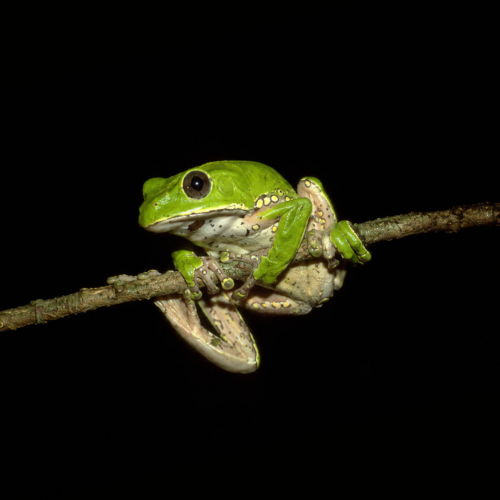
Before a kambo session can begin, the secretion needs to be collected. For this, the Phyllomedusa bicolor frog, a green frog with a white belly, is first caught in its natural habitat. It lives in the rainforests of the Amazon basin, including areas of Brazil, Colombia, Peru, Venezuela, Guyana, French Guiana, Suriname and Bolivia. The frog is then restrained, often with its limbs tied to sticks and stretched out. The stress this induces activates the frog's defence mechanism, in which the frog produces the secretion, which is then scraped from the skin and dried, often on a small wooden kambo stick, before being used in ritual settings. After collection, the frog is usually released back into the wild.
The origins of kambo rituals
Kambo rituals originated as a traditional folk medicine practice among several Indigenous peoples of the Amazon basin, especially in the western and southwestern Amazon. The ritual usually involves creating a series of burns and applying the dried kambo frog venom directly to these points on the skin. Kambo ceremonies are especially associated with Amazonian Indigenous groups such as the Katukina/Noke Kuin, Matsés, Marubo, Amahuaca, Kaxinawá/Huni Kuin, and Yawanawá. There are also ethnographic studies describing the use of kambo in traditional Noke Kuin medicine in Acre, in the Brazilian Amazon.
Traditional practitioners claim that the frog therapy aids fertility, increases strength, and brings good luck to hunters. Ethnographic sources also describe uses linked to expelling panema, often understood as bad luck, weakness, or negative energy, as well as cleansing the body and soul. Some sources also report traditional uses linked to inducing abortion or addressing laziness.
Are you interested in different traditions and rituals? Read our blog Shamanic medicine: All about differences between a cigarette and Rapé to learn more about Rapé, another herbal mixture with roots in Amazonian traditions. Ready to experience it firsthand? Browse our Smartshop to explore our selection of Rapé and shamanic products, including our traditional Kuripe bamboo.
What happens during a kambo ceremony?
During a kambo ceremony, the shaman or ceremony leader uses a hot stick, heated rod, or smoldering twig to create a series of small superficial kambo burns on the skin. These points are often made on the arm or leg, and in some traditional descriptions, on the upper arm for men or the lower leg for women, although this can vary. These small burns are the reason for the characteristic kambo scars, aka kambo dots, or kambo marks associated with the ceremony.
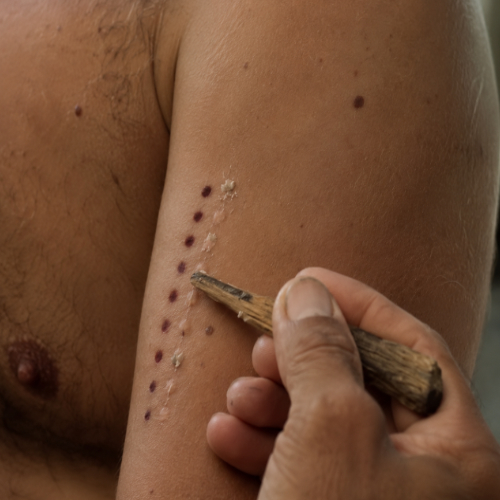
The dried kambo frog venom, sometimes mixed with water, saliva, or another liquid, is then applied to these points by the shaman or practitioner. This may sometimes be colloquially referred to as “frog venom injections” or even a “vaccine,” but it is not injected with a syringe or needle; it is applied to fresh burn wounds. This may be accompanied by singing, prayers, or other ritual elements like burning incense. The kambo is usually wiped off the skin within 15 to 20 minutes.
Acute effects of frog venom therapy
The bioactive peptides can enter the body quickly, and within minutes, the person receiving kambo may start experiencing acute symptoms, including:
- Heart palpitations, a sudden rush, and dizziness.
- Nausea, vomiting, and diarrhea (a bucket is often placed in front of the person receiving kambo, as vomiting is one of the most common reactions).
- Swelling around the eyes, lips, or face.
- An intense emotional or euphoric feeling after the main physical reaction has passed.
These kambo effects often resolve quickly, usually within about an hour. However, serious side effects have also been reported and will be discussed later in the blog.
Non-Indigenous use
Outside its traditional Amazonian context, kambo has spread into urban wellness and alternative therapy settings. In these settings, it is often marketed as a “kambo cleanse,” “frog venom cleanse,” or “kambo frog detox.”
There are also cultural and ethical concerns and critiques around modern frog poison treatment practices. Researchers and Indigenous individuals have raised concerns about cultural appropriation, the commercial use of Indigenous knowledge, and the possible impact on wild frog populations. So while kambo is often promoted as ancient frog medicine or frog poison cleanse, its modern use should be taken with respect and caution.
How does kambo work in the body?
So, how does kambo work, and what does kambo do after it is applied to the skin? The short answer is that kambo contains a complex mix of bioactive substances, including peptides, proteins, and alkaloids, that can interact with receptors in the body and trigger strong reactions.
Some of the best-established compounds in kambo frog venom include:
- Dermorphin and deltorphin, which act on opioid receptors and may influence pain perception and mood.
- Other peptides, such as phyllokinin and sauvagine, can affect blood vessels and blood pressure, which helps explain the flushing, dizziness, palpitations, and sudden feeling of a rush that many people report.
- Phyllomedusin and caerulein-like peptides can strongly affect smooth muscles and the digestive system, contributing to nausea, vomiting, cramps, diarrhea, and the intense purging reaction.
Claimed kambo benefits
Although claimed kambo health benefits are not supported by clinical evidence, people seek out kambo experiences for many reasons, including:
- Detox
- Energy
- Emotional release or mental clarity
- Spiritual growth or healing
- Anxiety
- Depression
- Addiction
- Pain relief
- Fertility boost
- Autoimmune conditions
- General healing
Disclaimer: This is not medical advice and is for educational purposes only. There is currently no medical proof that such frog poison therapy is safe or effective. If you are struggling with a health condition, make sure to consult a healthcare professional.
Kambo scientific research vs benefits
Kambo scientific research is still limited, and there is no good-quality evidence that kambo healing practices are safe or effective for any health condition. There are limited studies on isolated bioactive peptides found in Phyllomedusa bicolor secretion, and some of these compounds have attracted medical interest because they may affect pain pathways, blood vessels, the digestive system, or antimicrobial activity. However, so far, there is no clinical evidence proving any kambo cleanse benefits, nor kambo treatment benefits for any medical conditions.
Kambo side effects and risks
The acute physical effects of kambo can be very strong. Common effects include:
- Severe vomiting
- Diarrhea
- Sweating
- Dizziness
- Facial swelling
- Heart palpitations
- Blood pressure changes, especially sudden drops in blood pressure.
- Fainting
- Intense physical discomfort
- Water intoxication (hyponatremia; especially if kambo use is paired with excessive water intake)
More serious reactions linked to kambo use have also been reported, including:
- Psychosis
- SIADH (Syndrome of Inappropriate Antidiuretic Hormone Secretion; a condition where the body retains too much water, which can dilute sodium levels in the blood)
- Kidney damage
- Pancreas damage
- Liver damage, including toxic hepatitis
- Dermatomyositis
- Esophageal rupture
- Seizures
- Cases of death
That’s why the risks should not be underestimated. A kambo ceremony can be dangerous, and using kambo at home is especially risky because reactions can happen quickly and become severe.
While kambo rituals are an important tradition that should be approached with respect for the Indigenous cultures they come from, modern kambo healing practices should also be approached with caution and awareness of the risks.
FAQ: Frequently Asked Questions about Kambo
What is kambo therapy?
Kambo therapy is a ritual that involves creating a series of burns on the skin and applying frog secretion to those burns, but its claimed health benefits are not scientifically proven. You should approach all wellness claims critically and always prioritize evidence-based advice from licensed medical professionals.
Is kambo safe?
Kambo should not be considered medically safe or evidence-based. Its purported health benefits lack scientific proof, while its physical risks can be severe and potentially life-threatening. Clinical cases have linked the practice to organ damage, seizures, and death.
Can you buy kambo frog poison?
Kambo frog poison, kambo sticks, or kambo frog venom may be sold online in some places, but buying or using them can carry serious legal, safety, and ethical risks.
Is kambo legal?
Kambo’s legal status varies by country. In the Netherlands and wider EU, selling, importing, or promoting kambo may raise legal issues, especially if it is presented with medical, therapeutic, or food-related claims. Outside Europe, Australia classifies kambo as a Schedule 10 poison, Brazil has restrictions around its sale and medicinal promotion, and Chile has been reported to restrict import of the frog secretion. Always check current local laws before considering any kambo-related product or ceremony.
Is kambo psychedelic?
Kambo is often mentioned alongside psychedelics because it appears in similar ritual and retreat spaces, but it is not considered a classic psychedelic like psilocybin or LSD. Kambo and ayahuasca may both appear in purge-focused or emotional healing settings, and some retreats may combine them, but they work differently. Kambo’s effects are mainly physical, although some people report emotional release, mental clarity, or mild psychoactive effects.
Did you enjoy reading this article and do you like to write yourself? We are always looking for people who share our passion for natural products, who can also translate this into great texts. And we have an interesting reward for this. View all information for writers.
 Blog Cannabis
Differences between Sativa, Indica and Ruderalis
Most users have heard of Indica and Sativa. Weed is divided between these two strains (together with Ruderalis, more on this later). But what is the d [..]
07-09-2020
7 minutes
Blog Cannabis
Differences between Sativa, Indica and Ruderalis
Most users have heard of Indica and Sativa. Weed is divided between these two strains (together with Ruderalis, more on this later). But what is the d [..]
07-09-2020
7 minutes
 Blog Cannabis
Enjoying cannabis together (in times of corona)
Nowadays cannabis is more respected and appreciated in certain parts of the world. Interested parties include policymakers and companies. In the US, a [..]
31-12-2020
8 minutes
Blog Cannabis
Enjoying cannabis together (in times of corona)
Nowadays cannabis is more respected and appreciated in certain parts of the world. Interested parties include policymakers and companies. In the US, a [..]
31-12-2020
8 minutes
 Blog Psychedelics
Good Intentions for 2021 by a Psychonaut
To test how well we know ourselves, we can ask ourselves some questions. Do you know who you are? Do you know your strengths and weaknesses? Are [..]
Blog Psychedelics
Good Intentions for 2021 by a Psychonaut
To test how well we know ourselves, we can ask ourselves some questions. Do you know who you are? Do you know your strengths and weaknesses? Are [..]



 Nederlands
 Italiano
 Deutsch
 Français
 Português
 Español
 Polski