




 Spacemiles - Collect discount -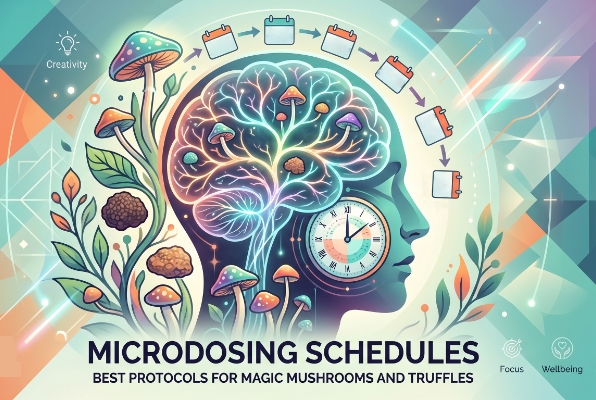
Microdosing Schedules: Best protocols for Magic Mushrooms and Truffles

Microdosing Schedules: Best protocols for Magic Mushrooms and Truffles
Do you want to start microdosing psilocybin and are wondering what microdosing schedule to follow? Read this blog to find out what microdosing schedules are, what the right dose and time of day are for microdosing, and how to avoid tolerance build-up.
What is microdosing?
Microdosing has become a popular practice among people looking to enhance their creativity, performance, motivation, or wellness, as well as individuals looking to manage their ADHD, depression, or anxiety symptoms. To do so, they regularly take tiny, non-hallucinogenic doses of psychedelics, like magic mushrooms or truffles, and swear by it as a holistic and natural way to achieve their peak wellbeing.
While scientific research is still catching up after the '60s war on psychedelics, there is a growing number of users and anecdotal reports pointing to real benefits from microdosing, especially when it’s done mindfully. Check out our blog on Everything you need to know about microdosing to find out more about microdosing benefits and the supporting science!
Disclaimer: While many people report positive experiences with microdosing, scientific research is limited and cannot rule out potential risks or adverse effects. This is especially important for more vulnerable individuals with psychological and/or physical conditions. Always consult your healthcare professional before starting to microdose.
Why follow a microdosing schedule?
If you are considering starting microdosing yourself, you might be wondering how to actually go about it. Is it something you take every day? What is the right dose for microdosing? And how do you avoid building tolerance? An answer to all your questions is having a clear microdosing schedule. A microdosing schedule is a special protocol indicating when and for how long you should microdose.
One of the most common misconceptions about microdosing magic truffles or mushrooms like Psilocybe cubensis is that you take them daily. It would actually be counterproductive, as the constant stimulation of the serotonin receptors may lead to tolerance build-up. To avoid it, it’s crucial to follow a microdosing schedule that will allow you to gain the great benefits of psilocybin (the active substance in magic mushrooms and truffles) without any risks.
Continue reading this blog to find out more about different microdosing mushroom protocols, why you should use one, and which is the best microdosing protocol to follow!
Microdosing schedules you should know about
Let’s jump right to it and break down the most important and popular microdosing mushroom schedules.
James Fadiman protocol
The James Fadiman microdosing protocol was designed by the “father of microdosing” - Dr. James Fadiman. It was originally created for microdosing psychedelics such as LSD, but now it's widely used for psilocybin mushrooms and truffles.
It introduces microdosing in a relatively slow and conservative way, where you microdose only on day 1, referred to as the microdosing day, which is followed by 2 days of rest. The 2nd day is called Transition day, during which you may still be able to feel the residual effects of psilocybin. Finally, the 3rd day is referred to as Normal day or Reflection day, which allows for a reset for your body (and neurotransmitters) to readjust back to baseline. You should take this time to reflect on the transformation you have experienced mentally, physically, and spiritually. Dr. James Fadiman suggests that this method is sufficient to establish the beneficial effects of microdosing while minimizing any adverse effects and also not wasting any extra mushrooms.
According to James Fadiman protocol, you should continue with such a 3-day microdosing schedule, repeating it for a full cycle of 1-2 months. After this period of time, you should take a 2-4 week break from taking mushrooms or truffles in order to avoid dependence or tolerance build-up.
- Day 1: Microdosing day
- Day 2: Transition day
- Day 3: Reflection day
- etc.
- Cycle: Continue for 1-2 months and take a 2-4 week break.
Paul Stamets' microdosing schedule
Paul Stamets microdosing protocol, also referred to as simply Stamets Microdosing Protocol or Stacking, was created by Paul Stamets, a renowned mycologist and passionate advocate for the medicinal properties of mushrooms (even those not psychedelic). He developed and tested a new microdosing mushroom schedule: a combo of psilocybin with niacin (vitamin B3), and the medicinal mushroom Lion’s Mane. Lion’s Mane, also known as Hericium erinaceus, is a mushroom that may offer benefits for brain health, such as supporting nerve regeneration and reducing symptoms of anxiety and depression. The addition of vitamin B3 also helps to maintain a healthy nervous system.
If you'd like to learn more about how Lion's Mane and magic truffles work together, check out our blog Microdosing with Magic Truffles and Lion's Mane, for a deeper dive.
Warning: a common side effect of taking niacin is the “niacin flush”, which is a harmless phenomenon that's normal for higher doses like 30-50mg or more. One of niacin’s working mechanisms leads to widening the skin’s blood vessels, increasing blood flow to the surface. This can cause temporary redness of the face, arms, and chest, a burning, prickling and/or itching sensation, and sometimes a headache. This phenomenon lasts between 10 and 60 minutes and is harmless.
According to Paul Stamets, this special combination has a positive, lasting effect on the behavior and neuroplasticity, so the growth of brain cells. Stamets' microdosing protocol refers to this combination as “stacking practice” and claims that it's the most efficient when used for 4 days straight, followed by 3 days of a break. These sets of 4 days on and 3 days off are meant to be repeated for up to a month and then followed by 2-4 weeks of rest.
- Days 1-4: Stacking Lion's Mane, psilocybin, and niacin.
- Days 5-7: Rest or Lion's Mane only.
- etc.
- Cycle: Continue for 1 month and take a 2-4 week break.
If you have decided to start microdosing with this protocol, buy the Paul Stamets microdose stack formula at Sirius.nl to make sure you have everything you need!
Fadiman vs Stamets dosing schedule: Pros and Cons
Fadiman and Stamets' microdosing psilocybin protocols offer two very different approaches, best suited for different groups of individuals. The Stamets Stack involves multiple consecutive days of microdosing and includes additional supplements that have more direct influence on neuroregeneration and brain health. On the other hand, it may seem complex or confusing, which may be troublesome if you're just starting. In contrast, the Fadiman protocol is often considered the most beginner-friendly and safest microdose regimen, requiring the conservative 2 days off, which is the best for those looking for a gentler introduction to microdosing.
Every other day microdosing mushrooms schedule
This is a microdosing psilocybin schedule designed by the Microdosing Institute, a research platform based in the Netherlands. It instructs users to microdose psilocybin every other day, which means you only experience microdosing day and Transition day without the additional off day proposed by the Fadiman protocol. This protocol is said to be particularly beneficial for people who microdose for medical reasons such as depression, anxiety, ADHD, or migraines. If that sounds interesting to you, make sure to check out our blog about how psilocybin can tackle your anxiety to find out more about the mechanism, risks, and benefits.
- Day 1: Microdosing day
- Day 2: Transition day
- etc.
- Cycle: Continue for 1-2 months and take a 2-4 week break.
Regardless of which microdosing schedule you choose to follow, make sure to get the best quality products, in order to achieve the true microdosing benefits. You can start with the most convenient option: check out our fresh microdosing truffles, or if you wanna do it like a true pro try growing your own magic mushrooms with a mushroom growkit from Sirius Smartshop!
Different microdosing protocols
There are also several less conventional psilocybin microdose protocols, variations, or personalized adaptations of the already discussed ones, designed to better suit individual needs. Below, you'll find an overview of these different psilocybin microdosing charts.
Intuitive microdosing schedule
This protocol is unique because you decide which days to microdose, following just one key rule: you must leave at least one transition day between microdosing days.
You can confidently begin intuitive microdosing only once you're able to clearly distinguish between your on and off days and recognize how your body responds to the microdosing. This ability is necessary for you to accurately assess its effects.
People who choose the intuitive approach usually have used the James Fadiman microdosing protocol previously. They microdose when it suits them or when they feel the need, when they seek an extra mental or emotional boost, or simply when it aligns with their lifestyle.
Fixed schedule microdosing - 2 days a week
This psilocybin microdosing protocol is a variation of the Fadiman method, with microdosing days fixed to specific days of the week, such as Monday and Thursday, rather than rotating each week. This approach is particularly beneficial for those who appreciate routine or aim to target specific goals on set days, such as productivity at work. A fixed microdosing schedule like this can help maximize the desired benefits.
- Monday: Microdose day
- Tuesday: Transition day
- Wednesday: Reflection day
- Thursday: Microdose day
- Friday: Transition day
- Saturday: Reflection day
- Sunday: Reflection day
- etc.
- Cycle: Continue for 1-2 months and take a 2-4 week break.
Nightcap microdosing protocol
This is a microdosing schedule that is designed for people who experience fatigue upon microdosing truffles or mushrooms. It utilizes the same microdosing cycle as any of the previously described microdosing protocols, with the exception of taking the microdose in the evening, at least 1 hour before sleep.
It allows the users to still benefit from microdosing, and additionally to use their tiredness to their advantage. They report more vivid dreams and tend to be more well-rested and wake up with a clear mind.
Other mushroom microdosing schedules
There are also more atypical microdosing schedules that are less popular and not as well-known.
One example involves microdosing only on weekends while taking weekdays off. This method may be suitable for busy individuals or beginners who want to try microdosing in a low-commitment way during their free time. There are also more microdose-heavy variations, for example, the 2:1 microdosing mushroom protocol, which involves two consecutive days of microdosing followed by one day off. There’s also the 7–7 method, which consists of microdosing for one full week followed by a full week of rest.
They also include periods of off-cycle for the tolerance break of 2-4 weeks after completing 1-2 months of following the microdosing protocol.
Best time of day to microdose
After finding out everything about different microdosing schedules, do you wonder what the best time of day is to microdose psilocybin? In fact, this depends on your personal characteristics and your body's reactions.
The usual option is to microdose in the morning. Psychedelics like truffles and mushrooms may influence the pulse or blood pressure, which, even in a microdose, can lead to mildly stimulating effects. Therefore, if you do it later in the day, you may struggle to fall asleep. However, some individuals experience fatigue after microdosing, and for them, the evening microdosing protocol is a better fit.
Additionally, you may ask: Is it better to microdose before or after a meal? Generally, it is recommended to start by taking the mushrooms after breakfast. Then, if your body responds well, you may try skipping breakfast on another microdosing day and see whether your experience is better/worse. If you normally microdose with a meal and then try it without one, the effects may come on quicker and feel more stimulating. It is important to get to know your own responses, as some people may experience nausea when taking the microdose before or conversely after/with a meal.
Always remember that again here, consistency is the key. You should keep the same routine for a minimum of 1 cycle to fully understand the changes between different strategies.
What is the right dose for microdosing?
Microdosing involves taking a small, sub-perceptual amount of magic truffles or mushrooms. The golden rule here is to take an amount that is between 1/20 and 1/10 of a normal dose that leads to a “trip”.
The optimal amount varies from person to person, but is usually between 0.1 and 0.5 grams of dried magic mushrooms, and for truffles, the dose is 0.5-1g. It is essential to start with the lowest possible dose and adjust if necessary. In theory, we could say that one of the factors to consider here is body weight, as the microdose metabolism and absorption depend on it. For instance, a person with lower body weight may need a smaller dose (0.1-0.2g of magic mushrooms) while someone heavier may need slightly more (0.2-0.3g). However, it is important to note that this claim is no longer officially supported by recent clinical research. Moreover, you should also consider why you are microdosing psilocybin. Therefore, if you are microdosing for more significant purposes such as supporting mental health, you may benefit from consulting a healthcare professional to find the right dose compared to if you are looking for a slight boost in creativity.
Note: Recent clinical studies (including those from Johns Hopkins University) have shown that body weight actually does not significantly affect the subjective effects or metabolism of psilocybin. A person's unique neurochemistry and metabolism play a much larger role.
Consistency is important, so keep a schedule that works for you and use high-quality digital scale or microdosing strips with pre-prepared magic truffle microdoses. Just remember to go low and go slow!
Which microdosing protocol is best for me?
At this point, you are probably wondering, "What is the best microdosing protocol to follow?" The best answer to that question is: there is no one single “best microdosing protocol.” You need to find what matches your needs best through trial and error. However, always remember to start with less and see if that works for you, and then possibly try a higher microdose frequency or dose. With that in mind, the safest and best microdosing schedule for beginners is the Fadiman protocol.
Another key consideration when finding the best microdosing chart for yourself is to establish the goal you are trying to achieve by taking up microdosing. Are you trying to aid your (mental) health and ease symptoms of depression, insomnia, anxiety, etc? Then you might benefit from higher microdose frequency, such as the every-other-day protocol. However, if you are microdosing for creativity, inspiration, and overall optimization, the Fadiman schedule may be sufficient. That said, experimenting with different protocols is a wonderful way to explore your personal relationship with psychedelics.
The important thing is to learn to differentiate the contrast between an ordinary and a microdosing day. We advise recording your personal experiences in a journal in order to thoroughly examine what microdosing can do for you. You can choose to switch to a different microdosing protocol after you complete your first full 1-2 month cycle or if you encounter negative side effects.
Get your own microdosing starter kit, and you are now ready to begin microdosing!
FAQ: Frequently Asked Questions about microdosing shrooms schedule
What is a microdosing schedule?
A microdosing schedule is a specific protocol that indicates when and for how long to microdose.
How often should I microdose mushrooms?
How often you microdose mushrooms depends on which shroom microdosing schedule you decide to practice. A good choice for beginners is the James Fadiman Protocol, which involves taking magic mushrooms or truffles in microdoses every three days. If you are more experienced or maybe wish for more stimulating effects, you may consider microdosing every other day.
Can you microdose every day?
The simple answer to the question is no, you should not microdose daily. Depending on the microdosing schedule you decide to follow, you should take mushrooms every 3 days, every 2 days, or for 4 days straight, followed by 3 days of a break, etc. Regardless of which microdose protocol you practice, it is important to take a 2-week break after microdosing for 1-2 months.
Should I microdose 4 days in a row?
If you decide to follow the Paul Stamets Protocol, you can microdose for 4 days in a row and then take a 3-day rest. According to this technique, you should do so for up to 1 month, after which you should take a 2-4 week rest before continuing with microdosing again.
What’s the best dosage for a beginner like me?
The rule of microdosing is to take between 1/20 and 1/10 of a regular dose of the psychedelic. So if you decide to take mushrooms, you should take between 0.1 and 0.3g, and in the case of truffles, 0.5-1g. If you are beginning your journey with microdosing psilocybin, you should try remaining at the lower side of this bracket.
How long to microdose?
The recommended duration depends on the microdosing schedule you follow; however, you should microdose for a full cycle of 1-2 months and then take a 2-4 week break. Then you can decide whether your goals have been reached or whether you want to continue with more microdosing cycles.
Did you enjoy reading this article and do you like to write yourself? We are always looking for people who share our passion for natural products, who can also translate this into great texts. And we have an interesting reward for this. View all information for writers.
 Blog Magic Mushrooms
How do I preserve my Magic Mushrooms?
Being self-sufficient gives a feeling of freedom. It may have something to do with the realization that you don't have to be completely dependent [..]
20-09-2021
8 minutes
Blog Magic Mushrooms
How do I preserve my Magic Mushrooms?
Being self-sufficient gives a feeling of freedom. It may have something to do with the realization that you don't have to be completely dependent [..]
20-09-2021
8 minutes
 Blog Health
Can you treat depression with a turmeric supplement?
The wide range of turmeric supplements is flying around you like leaves in Autumn. You can find them in every drugstore and the level of quality varie [..]
17-02-2023
8 minutes
Blog Health
Can you treat depression with a turmeric supplement?
The wide range of turmeric supplements is flying around you like leaves in Autumn. You can find them in every drugstore and the level of quality varie [..]
17-02-2023
8 minutes
 Blog Smart Products
Best natural Antidepressants Without Side Effects
Since the beginning of time, humans have used the healing power of nature to treat depression. Help with depression can be done with natural antidepre [..]
Blog Smart Products
Best natural Antidepressants Without Side Effects
Since the beginning of time, humans have used the healing power of nature to treat depression. Help with depression can be done with natural antidepre [..]



 Nederlands
 Italiano
 Deutsch
 Français
 Português
 Español
 Polski